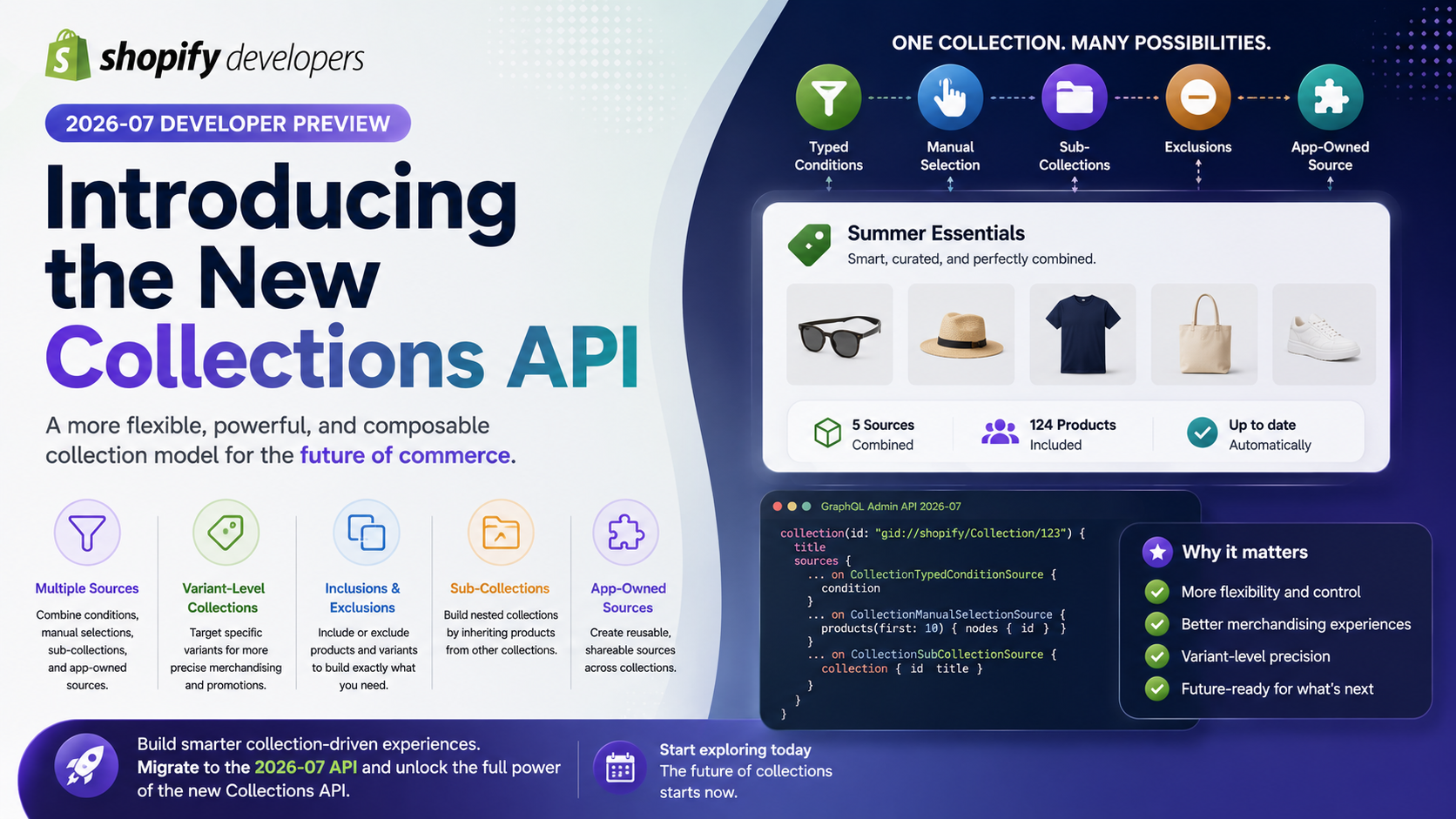
What’s New?
Instead of relying on a single ruleSet, a collection can now combine different sources, including:
This creates a much more powerful collection structure.
For example, a store could create a collection for "Summer Essentials" that combines automatically selected products, manually curated items, and products inherited from several sub-collections—all within one collection.
Variant-Level Collections
One of the most interesting improvements is variant-level targeting.
Developers can now create collections that target specific variants rather than entire products. This opens up new possibilities for experiences such as:
Shopify Functions also introduces ProductVariant.inCollections and ProductVariant.inAnyCollection, making variant-level collection membership available to functions.
What Developers Need to Do
If you're building a Shopify app that works with collections, this update requires attention.
Shopify recommends moving to the 2026-07 GraphQL Admin API and adopting the new sources model. Older API versions cannot represent collections that use new capabilities such as multiple sources, exclusions, sub-collections, or variant-targeted sources.
Several legacy fields and mutations are also deprecated, including:
Collection.ruleSetCollectionInputcollectionAddProductscollectionRemoveProductscollectionAddProductsV2collectionRulesConditionsThese remain available in 2026-07 for incremental migration, but developers should begin updating their integrations.
What About Webhooks?
The good news is that existing collection webhook topics remain unchanged. collections/create, collections/update, and collections/delete continue to work with the same triggers.
Why This Matters
The new Collections API gives Shopify developers much more flexibility when building merchandising, filtering, navigation, discount, and collection-management apps.
Instead of thinking of a collection as simply "a list of products", developers can now treat it as a combination of dynamic sources and rules.
This makes collections more powerful, scalable, and suitable for advanced commerce experiences.
Final Thoughts
The 2026-07 Collections API is a significant architectural change for Shopify developers. If your app relies heavily on collections, now is the right time to review your API implementation and start migrating from the legacy ruleSet model to the new composable sources model.
The earlier you update your integration, the easier it will be to support the new collection capabilities—including variant-level collections, exclusions, nested collections, and app-powered sources