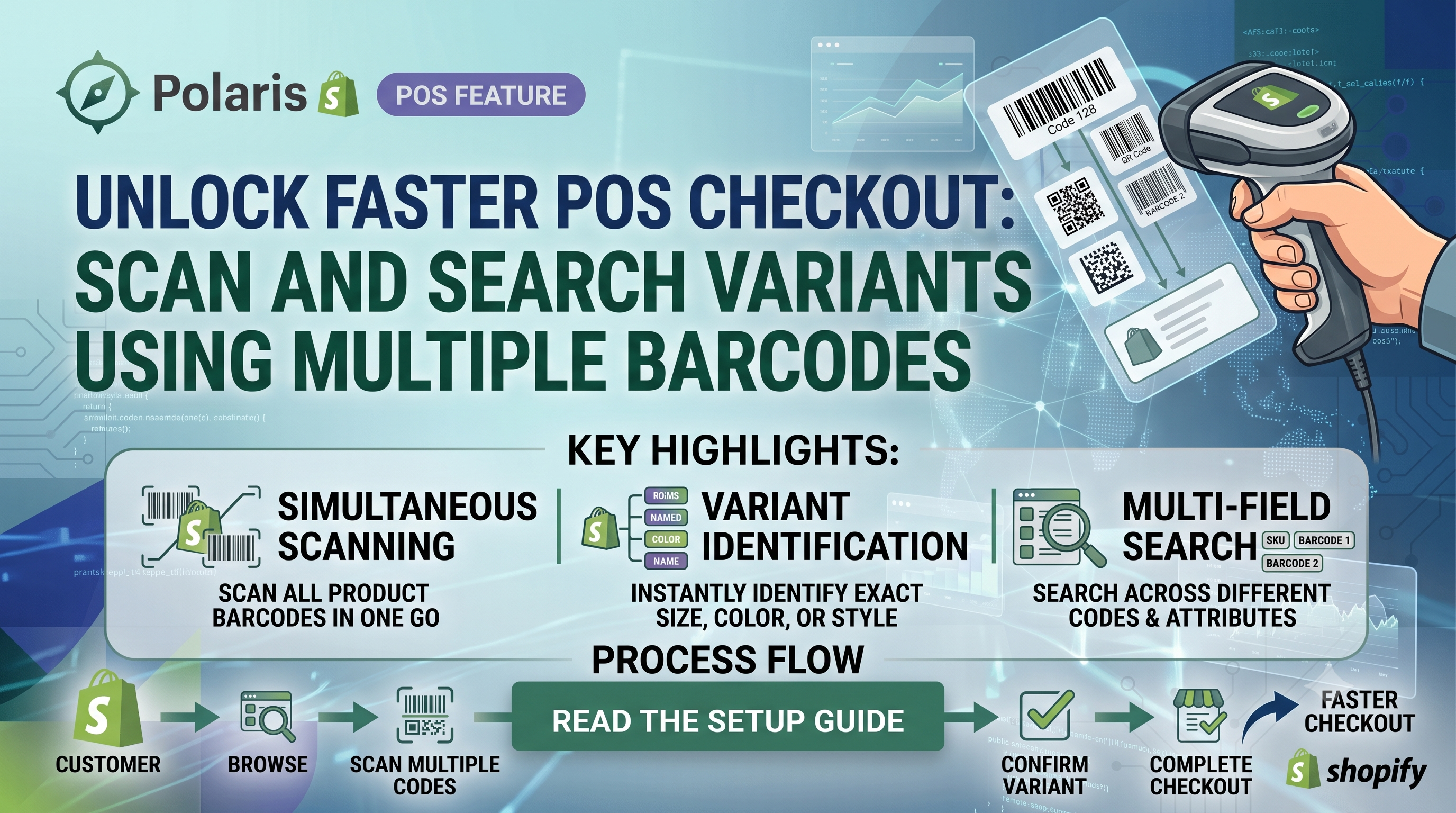
Unlock Faster POS Checkout: Scan and Search Variants Using Multiple Barcodes

Shopify POS now lets staff find any product variant by scanning any of its associated barcodes, reducing manual look‑ups and streamlining checkout, receiving, and inventory tasks.

Unlock Faster POS Checkout: Scan and Search Variants Using Multiple Barcodes
6 sections

Shopify merchants and developers have a new tool in their POS arsenal: the ability for Shopify POS (v11.14+) to locate a product variant by scanning any barcode linked to that variant. Whether you receive items from multiple suppliers, sell the same SKU in different packaging, or manage a complex catalog, this change removes the guesswork of barcode mismatches and speeds up checkout, receiving, and inventory workflows.

What’s Changing?

Previously, Shopify POS matched a scanned barcode only to the primary barcode stored on a variant. If a product carried additional barcodes—perhaps a supplier’s UPC, a barcode on a bundle, or a legacy SKU—staff had to look up the item manually or rely on a separate lookup table. The new update expands the barcode lookup to include every barcode attached to a variant, allowing any of them to trigger the same product result.

Who’s Affected?

The change is primarily a merchant‑facing improvement, but developers who build custom inventory or checkout apps need to be aware of the expanded matching logic. Merchants who already use multiple barcodes will see immediate benefits, while developers may need to adjust any custom validation that assumed a one‑to‑one barcode‑variant relationship.

How to Enable Multiple Barcodes

  • Open the Shopify admin and navigate to Products > All products. 2. Select the variant you want to edit. 3. In the Barcode (ISBN, UPC, GTIN, etc.) field, click Add another barcode (the UI now shows a plus icon). 4. Enter each additional barcode and click Save. 5. Ensure your store is running POS version 11.14 or later; the feature rolls out automatically.
  • For developers who prefer the API, the GraphQL productVariantUpdate mutation now accepts an array of barcodes via the barcode field. Example:

    graphql

    mutation {

    productVariantUpdate(input: {

    id: "gid://shopify/ProductVariant/1234567890",

    barcode: ["0123456789012", "9876543210987"]

    }) {

    productVariant {

    id

    barcode

    }

    userErrors {

    field

    message

    }

    }

    }

    Impact on Existing Integrations

    If your custom app queries variant.barcode assuming a single string, you’ll now receive the primary barcode only; the extra barcodes are stored in the barcode array (for GraphQL) or in the additional_barcode metafield for REST. Adjust your data models accordingly to avoid validation errors. The POS itself will automatically use the full set, so no front‑end changes are required for in‑store staff.

    Action Checklist

  • Verify POS version is 11.14 or newer (Settings > POS > About). - Add any missing barcodes to each variant in the admin. - Update any custom apps that validate barcodes to accept multiple values. - Test the workflow: scan a secondary barcode in POS and confirm the correct variant appears. - Communicate the change to staff so they know they can now scan any barcode on hand.
  • Conclusion

    Multiple barcode support removes a common friction point in high‑volume stores and simplifies inventory reconciliation across channels. By adding the extra barcodes in admin or via API, merchants unlock faster POS interactions, and developers keep their integrations future‑proof. Take a few minutes today to audit your catalog, update the barcodes, and let your team experience a smoother checkout.

    Ready to upgrade your barcode workflow? Log into Shopify Admin, add the extra barcodes, and share this guide with your POS team. For deeper API questions, drop a comment or contact our support.
    Tags
    Sources

    Related Articles

    Shopify Storefronts Now Support UCP 2026‑08‑25 – What Developers Need to Know
    Platform Updates

    Shopify Storefronts Now Support UCP 2026‑08‑25 – What Developers Need to Know

    Shopify’s storefronts now advertise support for the Universal Commerce Protocol version 2026‑08‑25, enabling seamless capability negotiation for platforms and agents. Learn what changed, who’s impacted, and the exact steps you should take.

    September 4, 20263 min
    Staff Can Now View Customers’ Online Carts Directly in Shopify POS
    Platform Updates

    Staff Can Now View Customers’ Online Carts Directly in Shopify POS

    Shopify POS v11.14 now lets authorized staff see an identified customer’s abandoned online cart at checkout. Learn who this impacts, how to enable the permission, and actionable steps to boost in‑store conversions.

    September 3, 20263 min
    Hydrogen Developer Preview Unleashed: Variant Links, Cart Refresh, and Local HTTPS Made Simple
    Platform Updates

    Hydrogen Developer Preview Unleashed: Variant Links, Cart Refresh, and Local HTTPS Made Simple

    Shopify’s Hydrogen preview adds variant‑specific links, automatic cart refresh, and one‑command local HTTPS certificates—essential upgrades for developers building custom storefronts. Learn what changed, who’s impacted, and how to implement them today.

    September 3, 20264 min
    Instant Connectivity Insight: New POS Home Status Icon
    Platform Updates

    Instant Connectivity Insight: New POS Home Status Icon

    Shopify POS now shows a real‑time connectivity icon right on the Home screen, letting staff confirm device readiness before checkout. Learn what changed, who it impacts, and how to make the most of this seamless update.

    September 1, 20264 min