Artificial Intelligence is rapidly changing how developers build applications—and now, it's beginning to transform how customers interact with online stores.
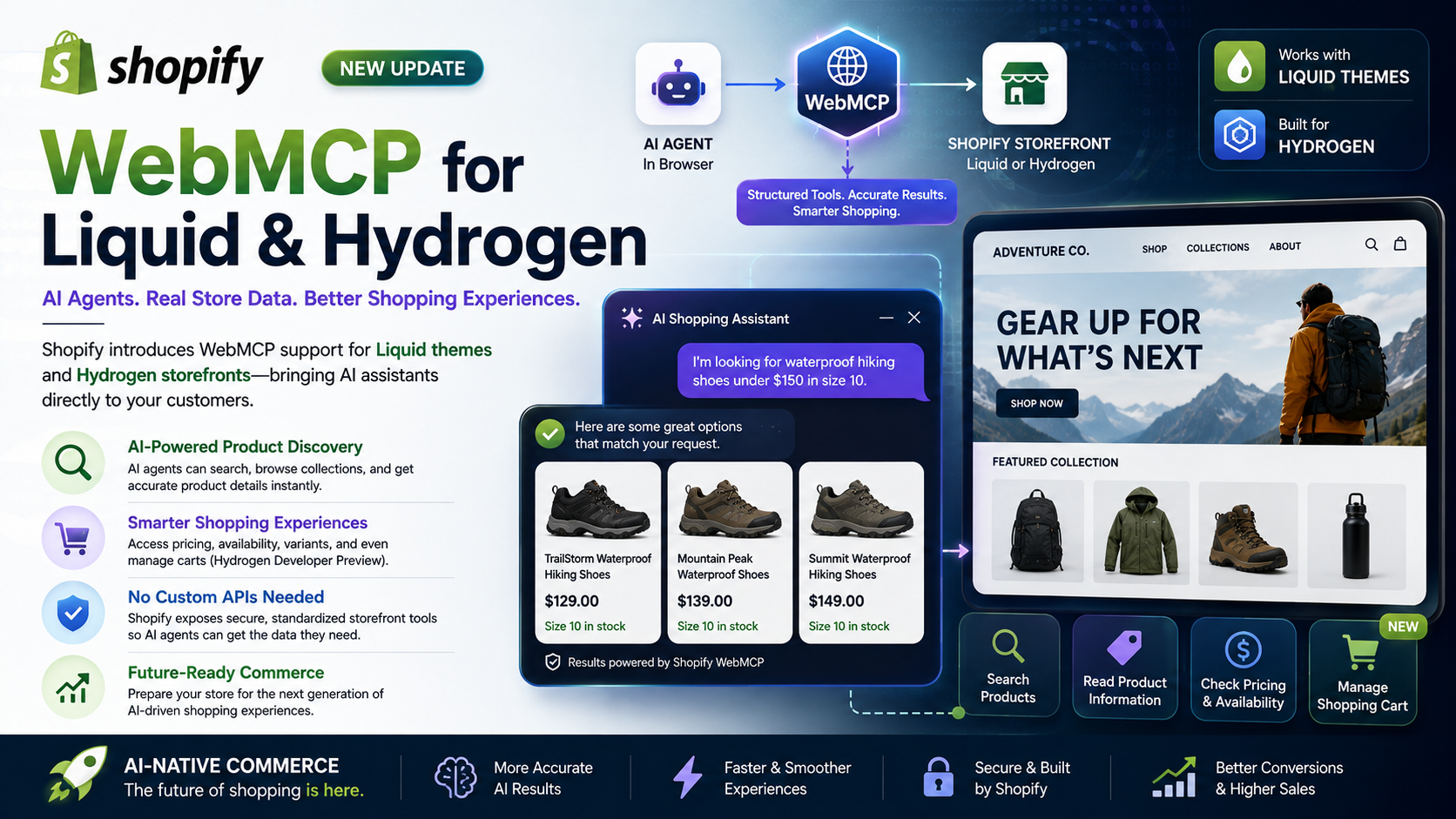
Shopify has introduced WebMCP support for both Liquid themes and Hydrogen storefronts, enabling AI agents running directly in a web browser to interact with storefronts in a secure and standardized way.
This isn't just another developer feature. It's Shopify's first major step toward an AI-native commerce experience, where AI assistants can search products, answer customer questions, and even help shoppers complete purchases—all without requiring merchants to build custom APIs.
What Is WebMCP?
Before diving into Shopify's implementation, let's understand the terminology.
MCP (Model Context Protocol) is an open protocol that allows AI models to communicate with applications through standardized tools instead of relying solely on text prompts.
WebMCP extends this concept into the browser.
Instead of asking an AI assistant to "guess" information from a webpage, the website exposes structured tools that AI can call directly.
Think of it like this:
Without WebMCP:
AI
↓
Reads HTML
↓
Attempts to understand page
With WebMCP:
AI
↓
Calls Store Tool
↓
Gets structured product data
This approach is significantly more reliable because the AI receives actual product information instead of trying to extract details from HTML.
Shopify now allows storefronts built with both:
to expose WebMCP tools that browser-based AI agents can use.
These tools allow AI to:
The best part?
For many storefronts, developers don't need to build these capabilities from scratch because Shopify provides the integration automatically through its platform.
Liquid Themes Now Become AI-Friendly
One surprising aspect of Shopify's announcement is that WebMCP isn't limited to headless storefronts.
Even stores using standard Online Store 2.0 Liquid themes can benefit.
Since Shopify renders and hosts these storefronts, it can automatically expose WebMCP capabilities without merchants needing to migrate to Hydrogen.
For millions of Shopify merchants, this means AI compatibility can arrive with little or no architectural changes.
Hydrogen Gets Even More Powerful
For developers building headless storefronts with Hydrogen, Shopify has taken things even further.
The latest Hydrogen Developer Preview introduces built-in WebMCP tooling alongside several other improvements, including:
These additions make Hydrogen not only faster but also more prepared for AI-driven shopping experiences
A Real Shopping Example
Imagine a customer opens an AI shopping assistant and asks:
"I'm looking for waterproof hiking shoes under $150 in size 10."
Without WebMCP:
The AI needs to:
With WebMCP:
The AI simply calls Shopify's product search tools and immediately receives:
The result is faster, more accurate, and significantly more reliable.
Benefits for Developers
For Shopify developers, WebMCP offers several practical advantages.
1. Less Custom API Development
Previously, integrating AI assistants often required building custom APIs.
Now, Shopify exposes standardized storefront tools, reducing development effort.
2. Better AI Experiences
AI assistants no longer rely on scraping HTML.
Instead, they receive structured product information directly from Shopify.
3. Future-Proof Storefronts
AI-powered shopping is expected to become increasingly common.
By adopting WebMCP early, developers can ensure their storefronts are ready for future AI commerce experiences.
4. Improved Maintainability
Because Shopify manages the underlying tooling, developers spend less time maintaining custom integrations and more time building great storefront experiences.