B2B for Everyone: Engineering the Shopify Spring '26 Democratization

With the launch of Shopify's Agentic framework—headlined by the dedicated Agentic Plan and Agentic Storefronts—the concept of a standard online store is being entirely unbundled. Consumers are no longer browsing grids of product cards; they are describing complex, highly contextual needs to autonomous AI agents across ChatGPT, Google Gemini, and Microsoft Copilot.

B2B for Everyone: Engineering the Shopify Spring '26 Democratization
6 sections

The Shopify Spring '26 Edition marks a pivotal shift in the platform's architecture. By moving business-to-business (B2B) primitives from the enterprise-only "Shopify Plus" tier into the core platform (Basic, Grow, and Advanced plans), Shopify has fundamentally changed how mid-market and SMB merchants approach wholesale.

For engineers and technical leads, this isn't just a UI update—it’s a realignment of the Shopify database schema and API accessibility.

1. The Core Realignment: B2B as a First-Class Citizen

Historically, B2B on Shopify required a $2,300/month Plus license. Merchants on standard plans relied on "workaround apps" that used tagged customer accounts and duplicate "wholesale-only" products.

In the Spring '26 update, the Company, CompanyLocation, and Catalog objects are now natively available across all plans. This means a single product variant can have multiple price points defined natively in the database, resolved dynamically at the checkout level based on the buyer's identity.

Key Architectural Differences

While the schemas are identical, Shopify uses "guardrails" to differentiate the tiers:

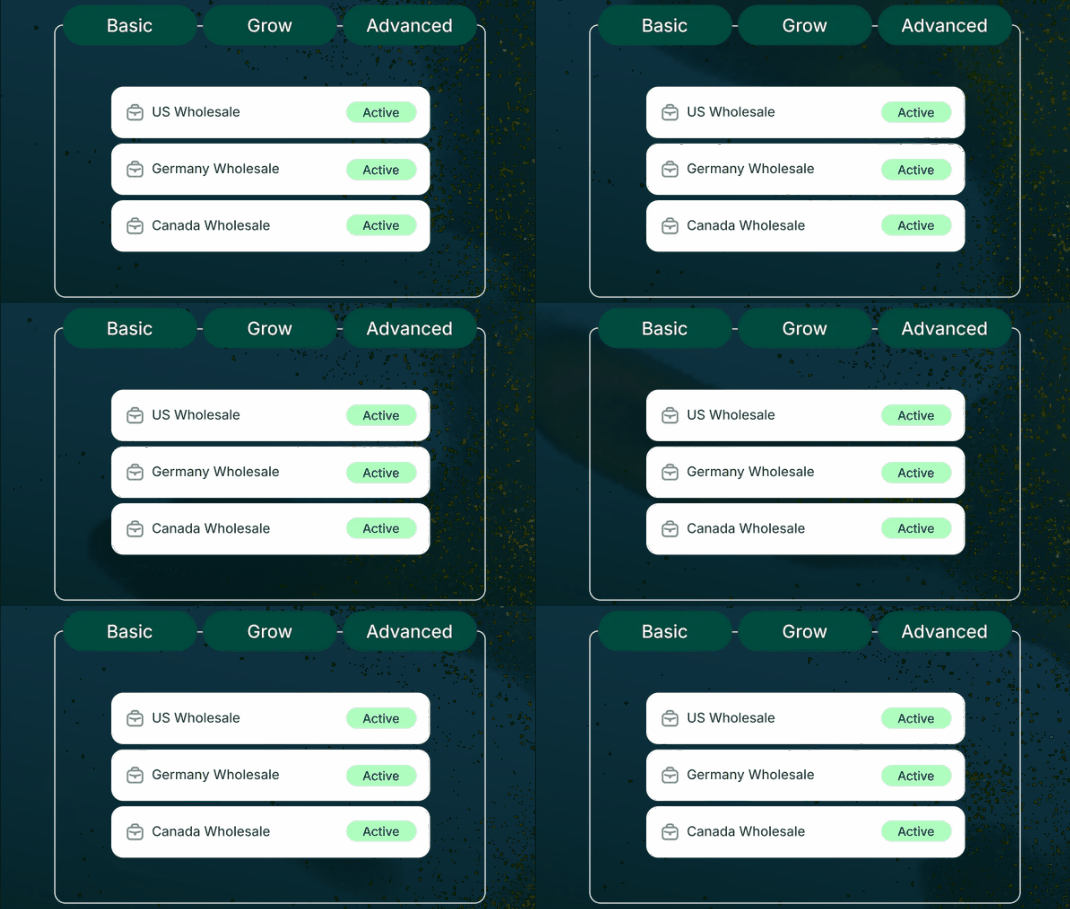
  • Standard Plans (Basic/Grow/Advanced): Limited to 3 active catalogs. Catalog assignment must be managed via Shopify Markets.
  • Shopify Plus: Unlimited catalogs with direct mapping to specific Company Locations.
  • 2. Implementing the "Three Catalog" Strategy

    On standard plans, catalogs are inherited from the Market context. To implement wholesale pricing without a Plus contract, you must follow this logical flow:

  • Enable New Customer Accounts: Native B2B requires the B2B-specific authentication flow; legacy accounts will not work.
  • Define the Company Node: Use the GraphQL companyCreate mutation to establish the business entity.
  • Market Association: Create a Market (e.g., "Wholesale USA") and assign the Company Location to it.
  • Catalog Publication: Create a Catalog and link it to that Market.
  • Developer Pro-Tip: The Catalog Limit

    Since you are limited to 3 catalogs on standard plans, you should use Percentage-Based Adjustments for broad tiers (e.g., "Silver", "Gold", "Platinum") rather than creating individual catalogs for every customer.

    3. The GraphQL API Layer

    Engineering teams can now integrate ERPs and CRMs with B2B endpoints on any plan. Here is how you initialize a wholesale price list adjustment via the API:

    json
    mutation UpdateCatalogPrice($priceListId: ID!) {
      priceListUpdate(id: $priceListId, input: {
        parent: {
          adjustment: {
            type: PERCENTAGE_DECREASE,
            value: 15.0
          }
        }
      }) {
        priceList {
          id
          name
        }
      }
    }

    This mutation applies a 15% discount across the entire catalog relative to the retail price. For specific contract prices, you can still use priceListFixedPricesAdd to override specific variants.

    4. Operational Guardrails and Incompatibilities

    Moving B2B to core plans doesn't mean every feature is supported. High-complexity checkouts are still gated. Technical leads should be aware of these hard limits:

  • Line Item Cap: Checkouts are capped at 500 line items. If your wholesale customers typically order 1,000+ variants, they will hit a hard wall.
  • Payment Gating: While ACH (US-only) is available, advanced flows like split-billing or custom deposits remain exclusive to Shopify Plus.
  • Feature Conflicts: Native B2B currently blocks subscriptions, local delivery, and traditional consumer tipping.
  • 5. The June 30th Deadline: Scripts to Functions

    Coinciding with this democratization is the final sunset of Shopify Scripts on June 30, 2026. All wholesale discounting logic must be migrated to Shopify Functions (WebAssembly).

    The Cart Transform API is now the primary tool for B2B customization:

  • lineExpand: For expanding bundle SKUs into components for fulfillment.
  • linesMerge: For consolidating multiple quantities into a single contract line item.
  • Strategic Conclusion

    The democratization of B2B features removes the "Plus gate" for growing brands. However, for developers, the challenge shifts from "how do we hack wholesale?" to "how do we optimize within the 3-catalog and 500-line-item limits?"

    If your merchant’s B2B volume exceeds $1.5M/year or requires high-throughput API limits, the transaction fee savings and direct catalog mapping of Shopify Plus still represent the most efficient technical architecture.

    Tags
    Sources

    Related Articles

    From Chatbot to Junior Teammate: Inside the Massive Sidekick Upgrade in Shopify Spring ’26
    Platform Updates

    From Chatbot to Junior Teammate: Inside the Massive Sidekick Upgrade in Shopify Spring ’26

    Shopify’s native AI assistant, Sidekick, has officially outgrown its role as a passive text generator. In this release, Shopify has transformed Sidekick into an active, multi-tasking, cross-app business assistant capable of taking asynchronous action on your behalf.

    June 25, 202615 min
    Shopify Ecosystem Updates You Need to Know
    Platform Updates

    Shopify Ecosystem Updates You Need to Know

    Stay ahead of the competition with the latest Shopify updates, including self-serve returns and cancellations, subscription purchase disclosures, and more. Learn how to leverage these updates to improve your store's performance and customer experience.

    June 21, 20262 min
    Unlock the Full Potential of Your Shopify Store: Recent Updates You Need to Know
    Platform Updates

    Unlock the Full Potential of Your Shopify Store: Recent Updates You Need to Know

    Stay ahead of the competition with the latest Shopify updates, including multi-currency payouts, unified staff management, and expanded Shopify Collective features. Discover how to leverage these updates to streamline your operations and boost sales.

    June 15, 20263 min
    What's New in Shopify: Updates to Enhance Your Store Management and Performance
    Platform Updates

    What's New in Shopify: Updates to Enhance Your Store Management and Performance

    Shopify has released several updates to improve store management, including unified staff permissions, shipping performance metrics, and new chart types in Shopify Analytics. This article covers the latest updates and provides actionable insights for Shopify merchants and developers.

    June 13, 20262 min