We are officially transitioning from the era of Search Engine Optimization (SEO) to Agent Engine Optimization (AEO).
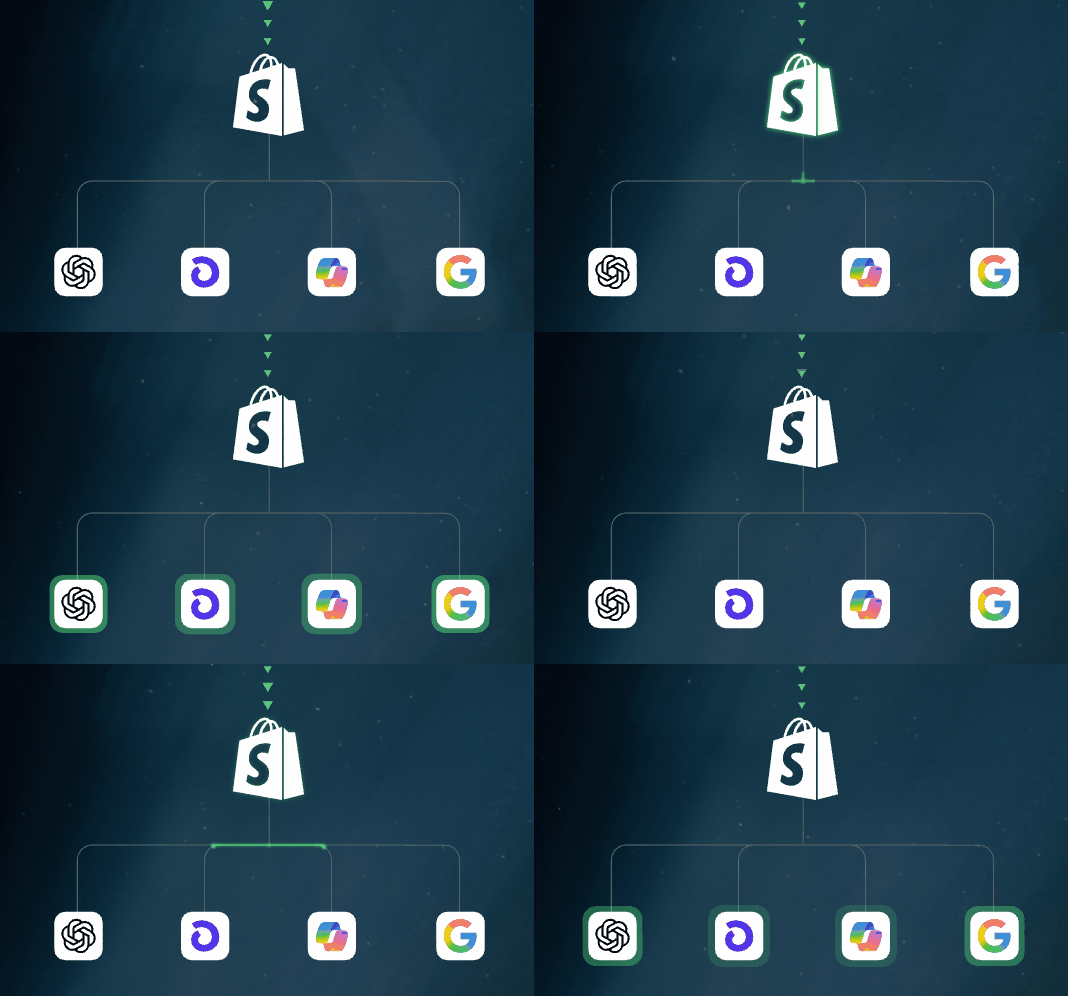
With the launch of Shopify's Agentic framework—headlined by the dedicated Agentic Plan and Agentic Storefronts—the concept of a standard online store is being entirely unbundled. Consumers are no longer browsing grids of product cards; they are describing complex, highly contextual needs to autonomous AI agents across ChatGPT, Google Gemini, and Microsoft Copilot.
If those agents can't read, verify, and purchase your products programmatically, your catalog effectively ceases to exist in the next phase of the web.
Below is a technical breakdown of how Shopify’s Agentic platform operates, the open protocols powering it, and the data architecture required to make your products discoverable by autonomous buyers.
The Architectural Core: Universal Commerce Protocol (UCP)
Historically, syndicating data to a new marketing or sales channel required custom ETL pipelines, API integrations, and continuous schema mapping. Multiplying this across a dozen rapidly evolving AI engines would create an unmaintainable web of integrations.
To solve this, Shopify co-developed the Universal Commerce Protocol (UCP) alongside Google. UCP acts as an open-standard semantic layer that translates structured product data into a deterministic, machine-readable format that any LLM or autonomous agent can digest natively.
UCP handles real-time verification of commerce primitives directly within a chat boundary:
Behind the Scenes: The Agentic Plan vs. Agentic Storefronts
Shopify is approaching this infrastructure with two distinct deployment models depending on your existing tech stack:
1. Agentic Storefronts (For Native Shopify Merchants)
If you already run on Shopify, Agentic Storefronts act as a built-in headless distribution channel. It automatically syndicates your structural product data to the Shopify Catalog—a highly optimized, multi-billion-item index built specifically for high-speed AI retrieval.
2. The Agentic Plan (For External/Legacy Stacks)
For enterprise systems trapped on legacy, monolithic, or heavily customized ERP/commerce setups, migrating to a new platform just to access AI channels is a non-starter. The Agentic Plan allows external platforms to inject their product catalogs directly into the Shopify ecosystem purely for AI distribution.
It strips away the requirement for a traditional HTML online store entirely. You plug your inventory feed into the backend, Shopify exposes it via UCP to the AI channels, and you leverage Shopify's high-converting, secure checkout loop directly inside the conversational interfaces while leaving your legacy system intact for your traditional web presence.
Optimization for AI Discovery: The New Schema Primitives
Traditional search engines rely on keyword relevance and basic structured schema (JSON-LD). AI agents, however, don't just index data—they reason over it. If an agent is tasked with finding "a rugged, weatherproof 360-degree action camera with native USB-C microphone input and a modular battery life exceeding 4 hours," basic title tags won't cut it.
To stay competitive, technical teams must shift their data management strategies toward deep semantic enrichment.
Optimization Layer
Technical Implementation
Impact on AI Agents
Granular Metaobjects
Define precise component-level specs (e.g., specific sensor dimensions, lens coatings, exact material grades) instead of relying on block text descriptions.
Allows LLMs to perform strict parameter filtering during multi-step reasoning processes.
Variant-Level Publishing
Utilize Shopify's updated variant controls to explicitly publish or restrict unique hardware configurations per market or AI channel.
Prevents agents from recommending out-of-stock or regionally incompatible hardware variants.
Automated JSON-LD Injections
Programmatically map complex technical attributes to deeply nested schema attributes behind the scenes.
Ensures agents can instantly verify edge-case product capabilities without hallucinatory guesswork.
Looking Forward: Programmatic Commerce
Building a storefront is no longer just about optimizing your DOM elements, minimizing layout shifts, or crafting beautiful visual cards for human eyes. As autonomous agents take over the discovery phase of the purchasing funnel, your API surface area is your store layout.
By adopting the Universal Commerce Protocol and leveraging headless catalog syndication, Shopify Agentic provides the structural groundwork to ensure your products are programmatically discoverable, verifiable, and instantly purchasable across every AI channel on the market